
For estate agents still using legacy networks, upgrading to the Linx AI phone system delivers a noticeable boost in terms of efficiency and productivity. Here’s what it does, why Linx is different to standard phone platforms, and where it fits into your current workflow.
Linx AI phone system vs traditional answering service
Here’s the typical client experience for connecting with their chosen estate agency. They dial the agency and, if lucky, are filtered through the PBX or IVR system to a live agent. If their regular contact or target agent is busy, the system redirects them to the next available person, or to voicemail.
Here’s why there’s room for improvement, both for the caller and the agent picking up the phone.
1. Industry statistics indicate that customers who don’t connect at the first time of asking to speak to a live agent are unlikely to hold or call back. In most cases, they will call another agency.
2. A busy agent taking a call has no context. They see a number on the screen without the time to prepare. That often means the first 30-45 seconds are devoted to establishing fundamental details.
Why Linx lets agents take calls differently
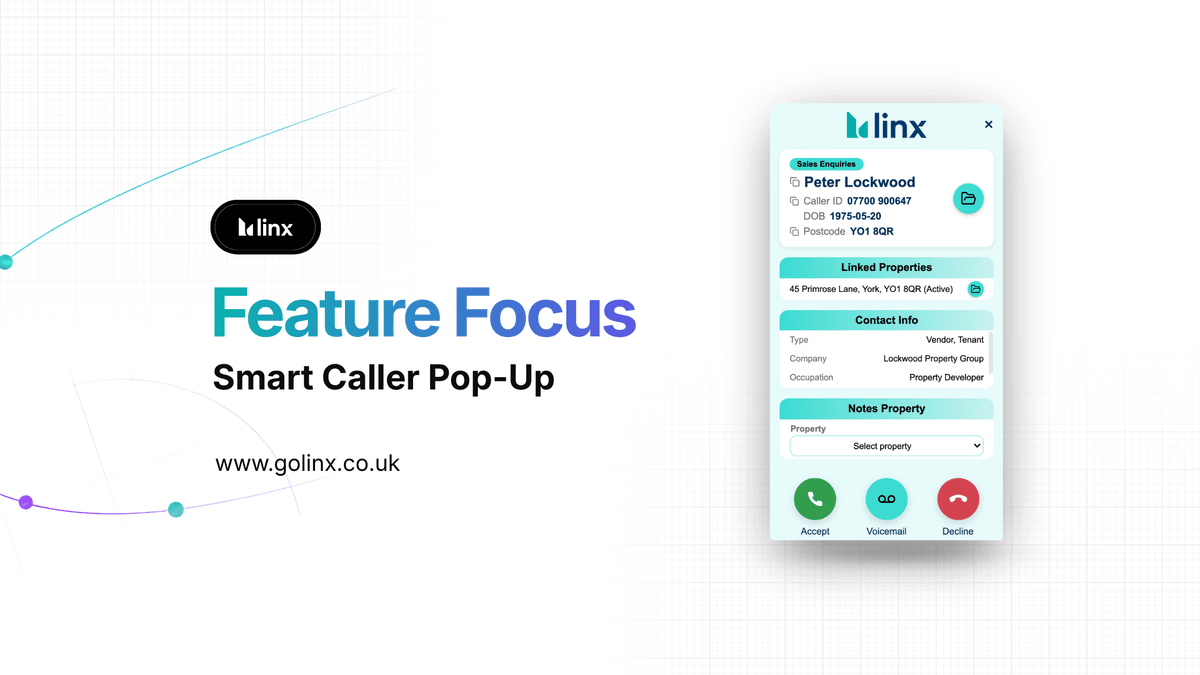
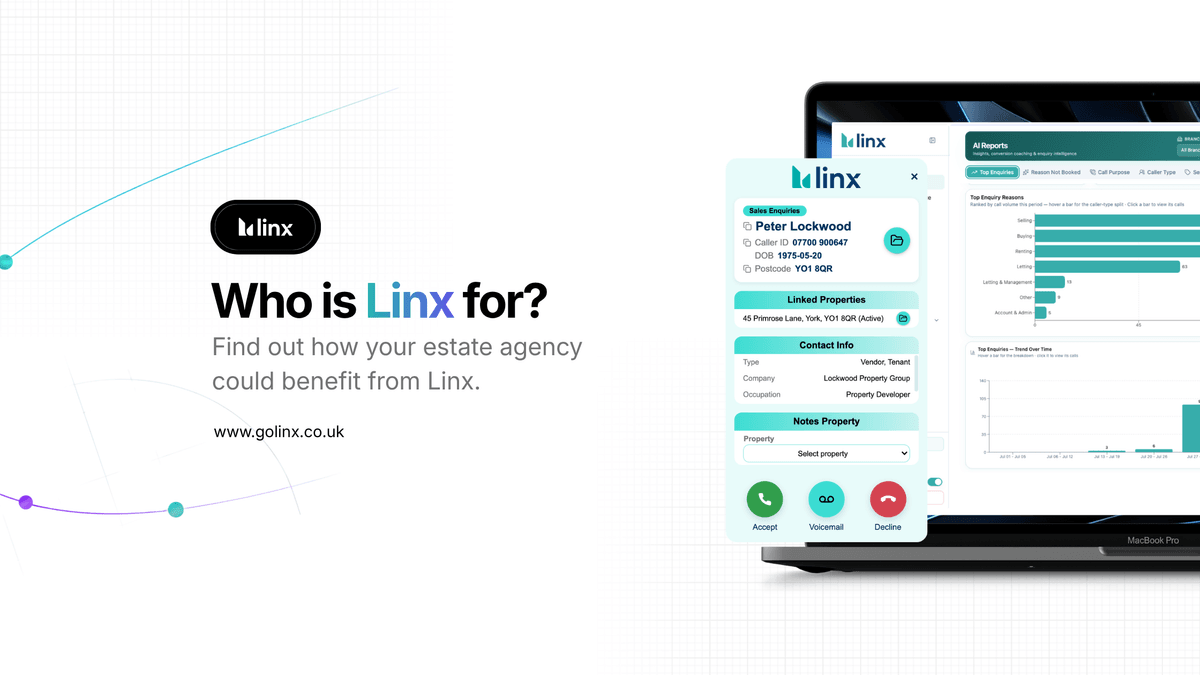
Linx smart caller pop-up recognises the number of any caller in the CRM and displays their full name, property and search history and past conversations on screen. As a result, the agent can greet the caller by name and resume communication from the last relevant milestone, not the very beginning.
For new callers whose number is not yet in the CRM, Linx AI phone system allows you to create a new record and saves it automatically at the end of the call.
Smoother communication also works in the other direction. Instead of searching for a client’s number and scrambling to locate their record, the agent can summon their file from the dashboard and call directly in one click without any need for a telephone handset.
Linx vs standalone voice agent
Proactive estate agents might already be testing the AI waters with an off-the-shelf voice agent. It’s certainly a slicker experience than leaving a voicemail, and solves the problem of out of hours calling. However, the benefits are limited.
1. Call handling quality varies considerably between agents. Some of the lower-end receptionists can sound robotic and stilted. Others struggle to complete a simple conversation successfully.
2. Somebody still needs to set up the integration to the agency CRM, grant permissions and provide ongoing support. That can often mean a period of acclimatisation during which technical support has to manage APIs and call settings to feed the relevant data to the appropriate form field.
How Linx answers the call differently
As two platforms in one, Linx combines a top-tier AI phone receptionist and AI phone system. Crucially, the AI phone receptionist can be primed with a custom dictionary during set up so that it responds with an authentic tone and vocabulary. It speaks fluently and humanly, with most callers unaware they were talking to AI.
Integration is also easy and intuitive. Linx AI phone system connects directly to the CRM the agency is already using, without the requirement for a third-party API to provide the bridge.
24/7 call handling with instant intelligence
One of the areas where Linx makes an instant, noticeable impact is in note-taking. Existing customers report time-saving measured in hours per day.
The status quo is for agents to scribble notes by hand during the call, then spend minutes after the call transferring them to the CRM. That’s the ideal scenario. The reality, however, is that another call will inevitably interrupt the sequence, or errors will creep in between note pad and database.
And if the call comes in out of hours or while the agent is on site for a viewing, even taking notes is ambitious.
How Linx transforms note taking
Linx AI phone system takes care of the whole process, leaving the agent’s hands free and their time unlimited. Linx posts the call recording, transcription, summary and analysis instantly to the CRM. It can also allocate next steps and tag the appropriate people. Instead of coming back to the office from a property or after the weekend to plough through voicemails, the agent finds a ready-made to-do list with all information neatly summarised.
From a compliance perspective – a particular area of concern for today’s estate agency – the automatic call transcription and tagging feature can be invaluable. Should a tenant, landlord or property manager have a dispute that threatens to reach court, the agency has a verifiable call recording and transcript ready to produce to confirm exactly what was said, promised and understood.
Visibility into team performance
Whether it’s a boutique local estate agency or a nationwide chain, call performance is hard to monitor and manage with a legacy system.
Conventional phone systems track no call data, both within the agency and from the client perspective. That leaves branch or group managers with little visibility into the strengths and weaknesses of their teams, or the areas where opportunities await.
How Linx illuminates the hidden insight
The key feature here is the conversation analysis tool, which interprets the call transcript and summary for performance indicators.
Was information conveyed accurately and clearly? Were all parts of the call completed, or were crucial opportunities lost during the opening or closing? Are teams fully capturing the opportunities, many of which could be concealed in hints or off-hand comments? On a more fundamental level, are the best-performing agents paired with the most profitable leads?
The level of intelligence, analytics and insight that Linx gathers is impressive. The simplicity with which it presents that data on a one-click-access dashboard goes far beyond any platform most agents will have worked with.
Built for estate agency workflows
A general-purpose system with a call centre-style AI answering service might be serviceable, but it lacks the context to support teams fully. In addition, integration is rarely as simple as ‘bolting on’ a phone system to your CRM. Retrofitting your AI phone system to match your CRM will inevitably lead to glitches and errors.
Linx offers native integrations with the leading CRM systems for estate agents. Instead of creating a second system to manage, it plugs straight in and is ready to go almost immediately.
There’s a huge step up in quality from a system built for businesses, and a platform designed specifically for estate agents. In planning Linx, we embarked on a mission to understand how estate agents work, what tools they need, and where frustrations arise. We then built a system whose full range of features they would actually use.
Want to upgrade from your legacy phone system to the next generation of smart AI phone systems?